
🚀 AWS CodePipeline | Jenkins vs AWS CodePipeline | Open Source vs AWS Managed
Understand AWS CodePipeline from scratch, how CI/CD orchestration works, how Jenkins compares with AWS CodePipeline, and the key differences between open-source/self-managed tools and AWS managed services.

📖 Introduction
CI/CD is one of the most important parts of modern DevOps.
When developers write and update application code, organizations need a reliable way to:
Write Code
    ↓
Integrate Code
    ↓
Build
    ↓
Test
    ↓
Deliver
Doing all these activities manually can be time-consuming and difficult to maintain.
This is where CI/CD automation tools come into the picture.
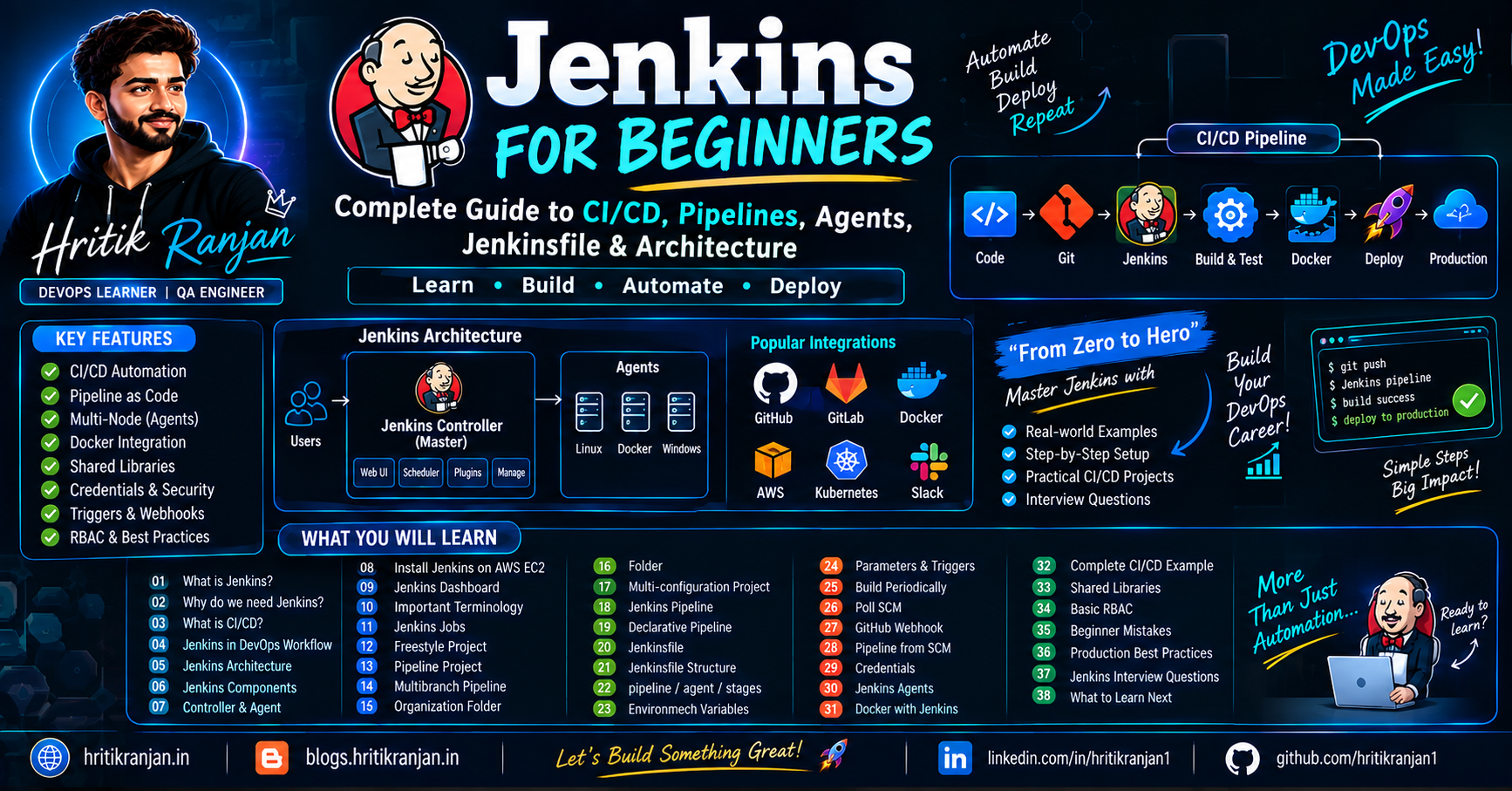
One of the most popular open-source tools used for CI/CD is Jenkins.
AWS also provides its own managed CI/CD services, including:
AWS CodePipeline
AWS CodeBuild
AWS CodeDeploy
In this blog, our main focus is AWS CodePipeline and how it compares with Jenkins.
The main question we will answer is:
What is the difference between using an open-source CI/CD tool like Jenkins and a managed AWS service like CodePipeline?
📚 Table of Contents
What is CI/CD?
What is CI/CD Orchestration?
What is Jenkins?
Jenkins as an Orchestrator
Jenkins Infrastructure Management
Jenkins Worker Nodes
What is AWS CodePipeline?
CodePipeline as a Managed Orchestrator
CodePipeline with CodeBuild
CodePipeline with CodeDeploy
Jenkins vs AWS CodePipeline
Open Source vs AWS Managed
Infrastructure Management Comparison
Flexibility Comparison
Multi-Cloud vs AWS-Centric Approach
Pay-As-You-Go Managed Experience
Advantages of Jenkins
Advantages of AWS CodePipeline
When to Choose Jenkins
When to Choose AWS CodePipeline
Simple Architecture Comparison
Practical CI/CD Learning Path
Interview Questions
Final Conclusion

🚀 What is CI/CD?
CI/CD represents practices used to automate software integration, testing, delivery, and deployment.
CI means:
Continuous Integration
CD can refer to:
Continuous Delivery
or:
Continuous Deployment
The basic idea is to automate the software delivery process instead of performing every step manually.
A simplified workflow looks like:
Developer
    ↓
Source Code
    ↓
CI
    ↓
Build
    ↓
Test
    ↓
CD
    ↓
Delivery / Deployment
🔄 Continuous Integration
Continuous Integration (CI) is the practice of frequently integrating code changes and automatically validating them.
For example:
Developer
    ↓
Code Change
    ↓
Git Push
    ↓
Build
    ↓
Test
The objective is to detect problems early.
Instead of waiting until the end of a project to integrate everyone's code, developers continuously integrate their changes.
🚚 Continuous Delivery
Continuous Delivery (CD) focuses on keeping the application ready for delivery.
A simplified flow can be:
Code
 ↓
Build
 ↓
Test
 ↓
Package
 ↓
Ready for Delivery
The release process can then move toward deployment.
⚡ Continuous Deployment
Continuous Deployment takes automation further.
When the required checks pass, the application can automatically be deployed.
Code
 ↓
Build
 ↓
Test
 ↓
Deploy
The exact implementation depends on the organization's CI/CD process.
🧠 What is CI/CD Orchestration?
This is the most important concept for understanding Jenkins vs AWS CodePipeline.
A CI/CD pipeline can contain multiple stages.
For example:
Source
   ↓
Build
   ↓
Test
   ↓
Delivery
Now imagine that different tools are responsible for these activities.
Something needs to coordinate the entire process.
This coordination is called orchestration.
🎯 What Does a CI/CD Orchestrator Do?
An orchestrator manages the sequence of activities in the pipeline.
For example:
Step 1
Source
   ↓
Step 2
Build
   ↓
Step 3
Test
   ↓
Step 4
Delivery
The orchestrator determines:
What should run first
What should run next
Whether the next stage should execute
What should happen when a stage succeeds
What should happen when a stage fails
Which service should perform a particular task
Both Jenkins and AWS CodePipeline can play this orchestration role.
🔧 What is Jenkins?
Jenkins is an open-source automation server commonly used to implement CI/CD pipelines.
Jenkins can coordinate different stages of a software delivery workflow.
For example:
Developer
    ↓
Source Repository
    ↓
Jenkins
    ↓
Build
    ↓
Test
    ↓
Delivery
Jenkins is not simply a build tool.
It can act as the central orchestrator that controls the overall CI/CD workflow.
🧩 Jenkins as a CI/CD Orchestrator
Consider this workflow:
Source Code
     ↓
    Jenkins
     ↓
    Build
     ↓
    Test
     ↓
   Delivery
Jenkins can control the sequence.
For example:
If Build succeeds
       ↓
Run Tests

If Tests succeed
       ↓
Continue to Delivery
If a stage fails:
Build
  ↓
FAIL
  ↓
Pipeline Stops
This is the orchestration responsibility.
🖥 Jenkins and Infrastructure Management
One of the important differences between Jenkins and AWS CodePipeline is infrastructure management.
Jenkins is open source.
That means the software is available for you to install and operate.
For example, an organization may run Jenkins on a server:
Server
   ↓
Jenkins
   ↓
CI/CD Pipeline
The organization becomes responsible for maintaining the infrastructure on which Jenkins runs.
👷 Jenkins Worker Nodes / Agents
Jenkins commonly uses worker nodes, also called agents, to execute jobs.
A simplified architecture looks like:
             Jenkins Controller
                     |
          ┌──────────┼──────────┐
          ↓          ↓          ↓
       Worker 1   Worker 2   Worker 3
          ↓          ↓          ↓
        Build      Test      Other Jobs
The workers perform the actual tasks assigned by Jenkins.
For example:
Jenkins
   ↓
Worker Node
   ↓
Build Application
   ↓
Run Tests
⚠️ Why Worker Management Matters
When using Jenkins, the team may need to think about:
How many workers are required
Worker capacity
Worker availability
Worker configuration
Worker maintenance
Scaling workers when workload increases
For example:
Small Workload
      ↓
1 Worker
But if many pipelines run simultaneously:
Large Workload
      ↓
Multiple Workers
      ↓
More Infrastructure Management
This is one of the operational responsibilities associated with a self-managed Jenkins setup.

☁️ What is AWS CodePipeline?
AWS CodePipeline is an AWS managed service used to automate and orchestrate software release workflows.
Instead of managing your own CI/CD orchestration server, AWS provides the managed CodePipeline service.
A simplified architecture is:
Source
   ↓
AWS CodePipeline
   ↓
AWS CodeBuild
   ↓
AWS CodeDeploy
The important point is:
CodePipeline acts as the orchestrator.
🧠 AWS CodePipeline as a Managed Orchestrator
CodePipeline can coordinate different stages of the CI/CD process.
For example:
Source
   ↓
CodePipeline
   ↓
Build
   ↓
Test
   ↓
Delivery
The actual work can be performed by other services.
For example:
                 AWS CodePipeline
                        |
          ┌─────────────┴─────────────┐
          ↓                           ↓
      CodeBuild                   CodeDeploy
          ↓                           ↓
      CI Activities              CD Activities
So the responsibilities are separated.
🔨 AWS CodeBuild for CI
AWS CodeBuild can be used for the CI part of the workflow.
For example:
CodePipeline
     ↓
CodeBuild
     ↓
Build
     ↓
Test
CodeBuild performs the actual build and test-related work.
CodePipeline coordinates when CodeBuild should run.
This gives us:
CodePipeline
=
Orchestration
and:
CodeBuild
=
Build + CI Activities
🚀 AWS CodeDeploy for CD
AWS CodeDeploy can be used for deployment-related activities.
The architecture can be:
CodePipeline
     ↓
CodeBuild
     ↓
CodeDeploy
Here:
CodePipeline
     ↓
Orchestrates
while:
CodeBuild
     ↓
CI / Build
and:
CodeDeploy
     ↓
CD / Deployment
This separation of responsibilities is important when understanding the AWS managed approach.
🏗 AWS Managed CI/CD Architecture
The AWS managed approach can be represented as:
                       Developer
                           ↓
                      Source Code
                           ↓
                  ┌─────────────────┐
                  │ AWS CodePipeline│
                  │  Orchestrator   │
                  └─────────────────┘
                           ↓
                    ┌─────────────┐
                    │ CodeBuild   │
                    │     CI      │
                    └─────────────┘
                           ↓
                    ┌─────────────┐
                    │ CodeDeploy  │
                    │     CD      │
                    └─────────────┘
The important concept is that AWS provides managed services for different parts of the workflow.
🔄 Jenkins Approach vs AWS Managed Approach
Let's compare the two approaches.
Jenkins
Source
   ↓
Jenkins
   ↓
Worker Node
   ↓
Build
   ↓
Test
   ↓
Delivery
The organization manages the Jenkins infrastructure.
AWS CodePipeline
Source
   ↓
AWS CodePipeline
   ↓
AWS CodeBuild
   ↓
AWS CodeDeploy
AWS manages the underlying CodePipeline service.
The user focuses more on configuring the pipeline and connecting the required services.
⚖️ Jenkins vs AWS CodePipeline
The biggest difference can be understood through this comparison:
| Area | Jenkins | AWS CodePipeline |
|---|---|---|
| Type | Open Source | AWS Managed |
| Role | CI/CD Orchestrator | CI/CD Orchestrator |
| Infrastructure | User-managed | AWS-managed |
| Worker Management | Usually required | No Jenkins-style worker management |
| Flexibility | Very high | More AWS-oriented |
| Platform Support | Broad | More AWS-centric |
| Multi-Cloud | Strong | More platform-restricted |
| Maintenance | More responsibility | Less infrastructure responsibility |
| Scaling Infrastructure | User responsibility | Managed by AWS service |
| CI Service | Jenkins can execute CI | CodeBuild can provide CI |
| CD Service | Jenkins can invoke deployment | CodeDeploy can provide CD |
| Management Model | Self-managed | Managed |
| Pricing Model | Open-source software + infrastructure costs | AWS service usage / pay-as-you-go model |

🆚 Open Source vs AWS Managed
Now let's understand the main concept behind this comparison.
🔓 Open Source Model — Jenkins
Jenkins is open-source software.
The basic idea is:
Download / Install
       ↓
Configure
       ↓
Maintain
       ↓
Run CI/CD
You have significant control over the environment.
This can provide a high level of flexibility.
But with greater control comes greater responsibility.
You may need to manage:
Jenkins
   ↓
Infrastructure
   ↓
Workers
   ↓
Configuration
   ↓
Maintenance
☁️ AWS Managed Model — CodePipeline
AWS CodePipeline is a managed AWS service.
The basic idea is:
Create Pipeline
       ↓
Configure Stages
       ↓
Connect Services
       ↓
Run Pipeline
You don't need to manage a Jenkins controller or Jenkins worker infrastructure for CodePipeline.
AWS manages the underlying CodePipeline service infrastructure.
Therefore:
Managed Service
        ↓
Less Infrastructure Management
🧠 Control vs Management
This is an important way to understand the difference.
Jenkins
More Control
     +
More Flexibility
     +
More Management
CodePipeline
Managed Service
     +
Less Infrastructure Management
     +
More AWS-Centric
There is a trade-off.
More control generally means more responsibility.
More managed infrastructure generally means less infrastructure management, but potentially more platform dependency.

🌍 Jenkins and Multi-Cloud Flexibility
One major advantage of Jenkins is its flexibility.
Jenkins can be used with different environments.
For example:
                 Jenkins
                    |
        ┌───────────┼───────────┐
        ↓           ↓           ↓
       AWS        Azure         GCP
This can be useful when an organization works across multiple cloud providers.
Jenkins is not limited to one cloud platform.
☁️ AWS CodePipeline and Platform Dependency
AWS CodePipeline is designed as part of the AWS ecosystem.
It can integrate with external source providers and other supported services, but its biggest strength is its AWS integration.
For example:
AWS CodePipeline
       ↓
AWS CodeBuild
       ↓
AWS CodeDeploy
This is very convenient when an organization is already heavily invested in AWS.
However, this can also mean that the architecture becomes more closely tied to AWS services.
🔒 Platform Restriction vs Flexibility
This gives us a simple comparison:
Jenkins
Jenkins
  ↓
AWS
Azure
GCP
Other Platforms
AWS CodePipeline
CodePipeline
     ↓
AWS Ecosystem
     ↓
AWS Services
Therefore:
Jenkins generally provides more platform flexibility, while CodePipeline provides a more AWS-centric managed experience.
💰 Pay-As-You-Go Managed Experience
Another important difference is the service model.
AWS CodePipeline follows the AWS managed-service model, where you pay according to applicable AWS usage and pricing.
This is often described as:
Pay-as-you-go
You don't purchase and maintain a Jenkins server just to run the orchestration software.
Instead, you use the AWS managed service.
💡 Important Point About "Free" Jenkins
Jenkins being open source does not mean the entire CI/CD environment costs nothing.
The Jenkins software itself is open source, but the infrastructure required to operate it can have costs.
For example:
Jenkins Software
       ↓
Server
       ↓
Worker Nodes
       ↓
Storage
       ↓
Maintenance
There can be infrastructure and operational costs.
So the comparison should not simply be:
Jenkins = Free
CodePipeline = Paid
A better comparison is:
Jenkins
=
Open Source Software
+
Infrastructure
+
Management
+
Maintenance
versus:
CodePipeline
=
Managed AWS Service
+
Usage-Based Pricing
+
Less Infrastructure Management

🛠 Infrastructure Management Comparison
Let's make the difference very simple.
Jenkins
                    Jenkins
                       ↓
              Infrastructure
                       ↓
                Worker Nodes
                       ↓
                 CI/CD Jobs
You need to manage the environment.
CodePipeline
                  CodePipeline
                       ↓
                AWS Managed Service
                       ↓
                 CodeBuild / Build
                       ↓
                CodeDeploy / CD
AWS manages the underlying CodePipeline infrastructure.
📈 Scaling Comparison
Jenkins
Suppose you have many jobs running at the same time.
Jenkins
   ↓
Worker 1
Worker 2
Worker 3
Worker 4
As the workload grows, you may need more workers.
This introduces additional infrastructure management.
CodePipeline
With CodePipeline, you don't manage Jenkins-style worker nodes for the orchestration service.
AWS manages the underlying service infrastructure.
The focus shifts from:
How do I maintain my CI/CD servers?
toward:
How should my pipeline work?
🔧 Maintenance Comparison
Jenkins
You may need to manage:
Jenkins installation
Jenkins upgrades
Worker nodes
Worker capacity
Infrastructure
Configuration
CodePipeline
AWS manages the underlying CodePipeline service.
Your main responsibility becomes configuring:
Source
Pipeline stages
Actions
Build integration
Deployment integration
This can significantly reduce infrastructure management.

🎯 When Should You Choose Jenkins?
Jenkins can be a strong choice when:
You Need Maximum Flexibility
If your organization requires highly customized CI/CD workflows, Jenkins gives you significant control.
You Work Across Multiple Platforms
For example:
AWS
+
Azure
+
GCP
Jenkins can provide a common orchestration layer.
You Want an Open-Source Solution
Jenkins is open source and has a large ecosystem.
You Want More Control Over Infrastructure
If your organization wants to control the CI/CD environment directly, Jenkins provides that flexibility.
☁️ When Should You Choose AWS CodePipeline?
AWS CodePipeline can be a strong choice when:
Your Organization is AWS-Centric
For example:
AWS
   ↓
CodePipeline
   ↓
CodeBuild
   ↓
CodeDeploy
You Don't Want to Maintain CI/CD Servers
With a managed service, AWS handles the underlying CodePipeline infrastructure.
You Prefer Managed Services
Instead of managing:
Server
 ↓
Jenkins
 ↓
Workers
you can focus on:
Pipeline
 ↓
Build
 ↓
Delivery
You Want AWS Integration
CodePipeline works naturally with other AWS services, particularly CodeBuild and CodeDeploy.
🆚 Simple Decision Table
| Requirement | Better Fit |
|---|---|
| Open-source CI/CD | Jenkins |
| Maximum flexibility | Jenkins |
| Multi-cloud environment | Jenkins |
| Custom CI/CD workflows | Jenkins |
| More infrastructure control | Jenkins |
| AWS managed orchestration | CodePipeline |
| Less CI/CD infrastructure management | CodePipeline |
| AWS-centric environment | CodePipeline |
| AWS-native CI/CD workflow | CodePipeline |
| Managed service model | CodePipeline |
This doesn't mean one tool is always better.
The correct choice depends on the organization's requirements.
🏗 Jenkins CI/CD Architecture
A simplified Jenkins workflow:
                     Developer
                         ↓
                    Source Code
                         ↓
                      Jenkins
                         ↓
                  Jenkins Worker
                         ↓
                       Build
                         ↓
                        Test
                         ↓
                      Delivery
The key point:
Jenkins orchestrates the workflow and the organization manages the required Jenkins infrastructure.
☁️ AWS CodePipeline Architecture
A simplified AWS-managed workflow:
                     Developer
                         ↓
                    Source Code
                         ↓
                 AWS CodePipeline
                    Orchestrator
                         ↓
                    AWS CodeBuild
                         ↓
                         CI
                         ↓
                   AWS CodeDeploy
                         ↓
                         CD
The key point:
CodePipeline orchestrates the workflow while AWS manages the underlying CodePipeline service infrastructure.
🔥 Jenkins vs CodePipeline — The Core Difference
The entire comparison can be summarized as:
                 JENKINS
                    ↓
              Open Source
                    ↓
             Self Managed
                    ↓
            More Flexibility
                    ↓
           More Responsibility
while:
             AWS CODEPIPELINE
                    ↓
              AWS Managed
                    ↓
        Less Infrastructure Management
                    ↓
          AWS-Centric Experience
                    ↓
            Pay-As-You-Go Model

🧠 Most Important Concept
Don't think:
"Jenkins is better."
or:
"CodePipeline is better."
Instead, think:
Which approach fits the organization's requirements?
If the organization wants:
Flexibility
+
Multi-Cloud
+
Control
+
Open Source
Jenkins can be a strong choice.
If the organization wants:
Managed Service
+
AWS Integration
+
Less Infrastructure Management
+
AWS-Centric CI/CD
CodePipeline can be a strong choice.
🔗 How CodePipeline, CodeBuild and CodeDeploy Work Together
This is extremely important to understand.
Each service has a different responsibility.
              AWS CodePipeline
                Orchestration
                     ↓
              AWS CodeBuild
                  CI
                     ↓
              AWS CodeDeploy
                  CD
CodePipeline
Coordinates the workflow.
CodeBuild
Performs CI-related build and test activities.
CodeDeploy
Performs deployment-related activities.
Together:
CodePipeline
     ↓
CodeBuild
     ↓
CodeDeploy
create an AWS-managed CI/CD workflow.
🧑💻 Jenkins Equivalent
Jenkins can perform or coordinate many of these activities itself or invoke other tools.
For example:
Jenkins
   ↓
CI
   ↓
Build
   ↓
Test
   ↓
Invoke Deployment
The important difference is that Jenkins provides the automation platform, while CodePipeline coordinates AWS managed services.
🚀 Practical Learning Path
The next step after understanding CodePipeline is to implement CI/CD practically.
A simple learning progression is:
GitHub
   ↓
AWS CodeBuild
   ↓
Simple CI
Then extend it to:
GitHub
   ↓
AWS CodePipeline
   ↓
AWS CodeBuild
   ↓
CI/CD Workflow
Then:
GitHub
   ↓
AWS CodePipeline
   ↓
AWS CodeBuild
   ↓
AWS CodeDeploy
   ↓
End-to-End CI/CD
This progression helps you understand the difference between:
Simple CI
and:
Complete CI/CD

🎯 What You Should Remember
If you remember only a few things from this article, remember these:
1. Jenkins is Open Source
Jenkins
=
Open Source Automation Server
2. Jenkins Can Act as an Orchestrator
Jenkins
   ↓
CI
   ↓
CD
3. Jenkins Requires Infrastructure Management
Jenkins
   ↓
Infrastructure
   ↓
Worker Nodes
   ↓
Maintenance
4. CodePipeline is AWS Managed
AWS CodePipeline
=
Managed CI/CD Orchestrator
5. CodePipeline Can Use CodeBuild for CI
CodePipeline
      ↓
CodeBuild
      ↓
CI
6. CodePipeline Can Use CodeDeploy for CD
CodePipeline
      ↓
CodeDeploy
      ↓
CD
7. Jenkins is More Flexible
Jenkins
   ↓
AWS
Azure
GCP
Other Platforms
8. CodePipeline is More AWS-Centric
CodePipeline
      ↓
AWS Ecosystem
9. Jenkins Gives More Control
But:
More Control
     ↓
More Management
10. CodePipeline Gives a Managed Experience
Managed Service
       ↓
Less Infrastructure Management

❓ Interview Questions
Q1. What is AWS CodePipeline?
Answer:
AWS CodePipeline is a managed AWS service that automates and orchestrates stages of the software release process.
Q2. What is Jenkins?
Answer:
Jenkins is an open-source automation server commonly used to implement and orchestrate CI/CD pipelines.
Q3. What is the main difference between Jenkins and AWS CodePipeline?
Answer:
Jenkins is an open-source tool that is typically self-managed, while AWS CodePipeline is a managed AWS service. Jenkins provides more flexibility and control, whereas CodePipeline reduces the infrastructure management burden.
Q4. Why does Jenkins require infrastructure management?
Answer:
A self-managed Jenkins setup requires infrastructure to run the Jenkins controller and, depending on the workload, worker nodes or agents that execute pipeline jobs.
Q5. What are Jenkins worker nodes?
Answer:
Jenkins worker nodes, also called agents, are execution environments used to run CI/CD jobs assigned by Jenkins.
Q6. What is CI/CD orchestration?
Answer:
CI/CD orchestration means coordinating different stages of a software delivery workflow, such as source, build, testing, and delivery/deployment.
Q7. Is AWS CodePipeline an orchestrator?
Answer:
Yes. CodePipeline acts as a managed orchestrator that coordinates pipeline stages and actions.
Q8. What is the role of AWS CodeBuild in CodePipeline?
Answer:
CodeBuild can perform CI-related activities such as building and testing the application, while CodePipeline orchestrates when those activities should run.
Q9. What is the role of AWS CodeDeploy in CodePipeline?
Answer:
CodeDeploy can perform deployment-related activities, while CodePipeline coordinates the deployment stage as part of the overall pipeline.
Q10. Which is more flexible, Jenkins or CodePipeline?
Answer:
Jenkins is generally more flexible because it is open source, highly customizable, and can integrate with a broad range of platforms and tools.
Q11. Which is better for a multi-cloud environment?
Answer:
Jenkins can be a strong choice for multi-cloud environments because it can orchestrate workflows across different cloud platforms and infrastructure.
Q12. Why might AWS CodePipeline be preferred in an AWS-centric organization?
Answer:
Because CodePipeline is a managed AWS service and integrates naturally with AWS services such as CodeBuild and CodeDeploy, reducing the need to manage CI/CD infrastructure.
Q13. Does open source mean Jenkins has no cost?
Answer:
No. Jenkins software is open source, but infrastructure, worker nodes, storage, maintenance, operations, and other resources can still create costs.
Q14. What does pay-as-you-go mean for AWS CodePipeline?
Answer:
It means you use the managed AWS service and pay according to applicable AWS usage and pricing rather than purchasing and maintaining your own CI/CD orchestration infrastructure.
Q15. Which one should an organization choose?
Answer:
It depends on requirements. Jenkins may be preferred for flexibility, customization, and multi-cloud environments. CodePipeline may be preferred for AWS-centric environments where a managed CI/CD orchestration service and reduced infrastructure management are priorities.
⚡ Quick Revision
Jenkins
│
├── Open Source
├── Self Managed
├── CI/CD Orchestrator
├── Worker Nodes / Agents
├── Highly Flexible
├── Multi-Cloud Friendly
└── More Infrastructure Management
AWS CodePipeline
│
├── AWS Managed Service
├── CI/CD Orchestrator
├── Uses CodeBuild for CI
├── Uses CodeDeploy for CD
├── Less Infrastructure Management
├── AWS-Centric
└── Pay-As-You-Go Model
🏆 Final Conclusion
AWS CodePipeline and Jenkins both solve an important CI/CD problem: orchestrating the software delivery workflow.
But they follow two different approaches.
Jenkins represents the open-source and self-managed model.
Jenkins
   ↓
Open Source
   ↓
Self Managed
   ↓
Worker Nodes
   ↓
More Control
   ↓
More Management
AWS CodePipeline represents the managed AWS model.
CodePipeline
   ↓
AWS Managed
   ↓
CodeBuild
   ↓
CI
   ↓
CodeDeploy
   ↓
CD
The key trade-off is:
Jenkins gives you more flexibility and control, while AWS CodePipeline gives you a managed experience with less infrastructure management.
Jenkins can be especially useful when an organization needs:
Open-source tooling
High flexibility
Custom CI/CD workflows
Multi-cloud support
More control over the environment
AWS CodePipeline can be especially useful when an organization needs:
AWS-native CI/CD
Managed orchestration
Less infrastructure management
Integration with AWS CodeBuild and CodeDeploy
A pay-as-you-go service model
Therefore, there is no universal winner.
The right choice depends on the organization's infrastructure, cloud strategy, engineering skills, flexibility requirements, and willingness to manage CI/CD infrastructure.
🚀 Final Takeaway
Remember this simple comparison:
                 JENKINS
                    ↓
              Open Source
                    ↓
             Self Managed
                    ↓
            More Flexibility
                    ↓
           More Management
and:
            AWS CODEPIPELINE
                    ↓
              AWS Managed
                    ↓
             CodeBuild → CI
                    ↓
            CodeDeploy → CD
                    ↓
        Less Infrastructure Management
Jenkins = More control + More management
AWS CodePipeline = Managed experience + Less infrastructure management
Understanding this difference is more important than simply memorizing the names of the tools.
In the next practical step, you can start with a simple GitHub + AWS CodeBuild CI setup and then extend it into a complete AWS CI/CD pipeline using CodePipeline.
🚀 Continue Your Learning Journey
Thank you for taking the time to read this article.
Technology is evolving rapidly, and continuous learning is one of the most valuable investments you can make in your career. Whether you're exploring DevOps, Cloud Computing, Artificial Intelligence, Cybersecurity, Software Development, Data Science, or Career Growth, the resources below can help you deepen your knowledge and stay ahead in the industry.
🎓 Recommended Learning Platforms
🚀 Coursera
Learn from world-renowned universities and industry leaders including Google, IBM, Stanford, Microsoft, Meta, and many more.
✔ Professional Certificates ✔ Career-focused Learning Paths ✔ AI & Machine Learning Programs ✔ Cloud & DevOps Certifications ✔ Business & Leadership Courses
🔗 https://imp.i384100.net/k0KvbV
💻 Udemy
One of the largest online learning platforms with practical, hands-on courses covering:
✔ DevOps & Kubernetes ✔ Docker & Cloud Computing ✔ AWS, Azure & GCP ✔ Programming & Development ✔ Cybersecurity & Ethical Hacking
🔗 https://trk.udemy.com/MAL2MY
📊 DataCamp
A great platform for anyone interested in:
✔ Python Programming ✔ SQL & Databases ✔ Data Analytics ✔ Machine Learning ✔ Artificial Intelligence
Interactive learning paths and hands-on projects make it ideal for beginners and professionals alike.
🔗 https://datacamp.pxf.io/nX4kER
🎓 edX
Access high-quality courses and certifications from leading institutions such as:
✔ Harvard University ✔ MIT ✔ Berkeley ✔ Microsoft
Perfect for learners seeking university-level education online.
🎨 Domestika
Enhance your creative skills with courses on:
✔ Graphic Design ✔ Video Editing ✔ Animation ✔ Digital Marketing ✔ Content Creation
🔗 https://domestika.sjv.io/dynKAW
🛠️ Recommended Tools & Resources
🔥 AppSumo
Discover exclusive lifetime deals on:
✔ AI Tools ✔ Productivity Software ✔ Developer Utilities ✔ Marketing Platforms ✔ Business Applications
A must-have resource for developers, creators, freelancers, and entrepreneurs looking to save money while accessing premium tools.
🔗 https://appsumo.8odi.net/L04a33
🛒 Shopify
Looking to start an online business or launch an eCommerce store?
Shopify provides everything you need to build, manage, and scale an online business.
✔ Online Store Builder ✔ Payment Integration ✔ Inventory Management ✔ Marketing Tools
🔗 https://shopify.pxf.io/Vxv09k
🌐 WordPress, WooCommerce & Jetpack
Create professional websites, blogs, and online stores with one of the most trusted web ecosystems in the world.
Ideal for:
✔ Personal Blogs ✔ Portfolio Websites ✔ Business Websites ✔ eCommerce Stores
🔗 https://automattic.pxf.io/Z6vR5W
🌍 Language Learning Resources
🗣️ Preply
Learn English and other languages through personalized one-on-one tutoring sessions with experts from around the world.
🔗 https://preply.sjv.io/o4gBDY
📚 British Council English Online
Improve your professional communication skills and English fluency through structured learning programs.
🔗 https://englishonline.sjv.io/9VOGa4
🧠 Rosetta Stone
One of the most recognized language-learning platforms for immersive language acquisition.
🔗 https://aff.rosettastone.com/X4OyqG
🧪 Science & Educational Resources
🔬 MEL Science
Interactive science kits and educational experiences designed to make STEM learning engaging and practical.
🔗 https://imp.i328067.net/bk2beg
📖 Carson Dellosa Education
Educational materials and learning resources for students, teachers, and lifelong learners.
🔗 https://carsondellosaeducation.sjv.io/E0JbjW
❤️ Support My Work
Creating detailed technical content, tutorials, guides, and learning resources takes significant time and effort.
If you find my articles helpful and would like to support my work, you can do so through the following platforms:
⭐ Become a GitHub Sponsor
Support my open-source contributions, technical content, and community projects.
🔗 https://github.com/sponsors/hritikranjan1
☕ Buy Me a Chai
Enjoying my content? Consider buying me a chai and supporting future tutorials, guides, and educational resources.
🔗 https://www.chai4.me/hritikranjan
👨💻 Connect With Me
Hritik Ranjan
💡 AI Enthusiast ☁️ DevOps Learner 🔐 Cybersecurity Advocate 💻 Software Developer
Connect & Follow
🔗 GitHub: https://github.com/hritikranjan1
🔗 LinkedIn: https://linkedin.com/in/hritikranjan1
📢 Found This Article Helpful?
If this article added value to your learning journey:
✅ Share it with your network
✅ Bookmark it for future reference
✅ Follow for more DevOps, AI, Cloud, Cybersecurity, and Software Engineering content
Thank you for reading and being part of this learning journey.
Keep Learning. Keep Building. Keep Growing. 🚀